
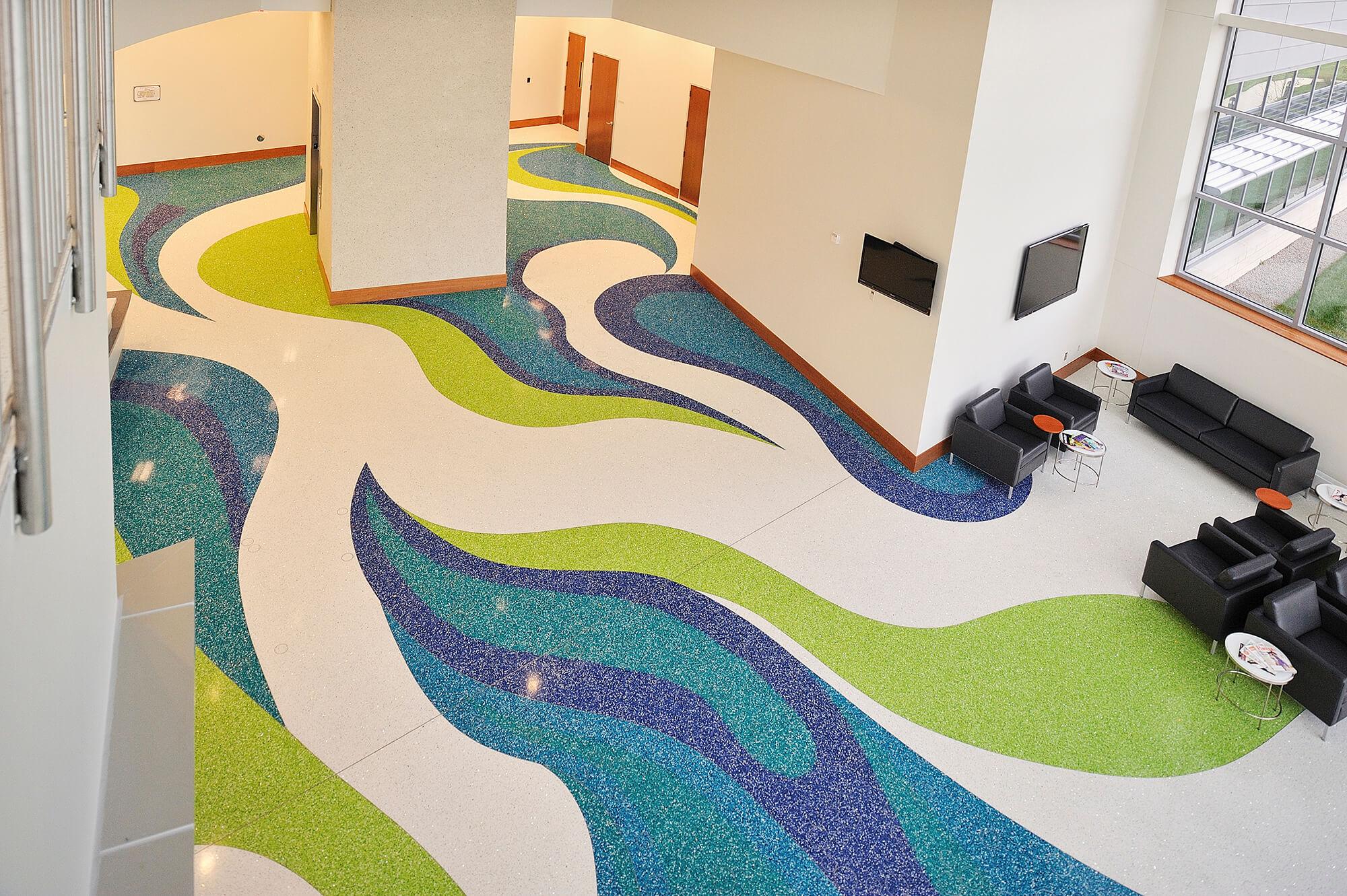
The first winter test of a commercial floor rarely happens in the middle of the building. It happens just inside the entrance: wet shoes, gritty wheels, a saturated mat, and a line of people who cannot wait for the lobby to dry.
For northeast Indiana schools, offices, healthcare facilities, stores, and public buildings, October is a useful time to walk that route before conditions change. The goal is not to make every floor look newly installed. It is to understand what you have, address visible defects, and give the maintenance team a plan that fits the actual building.
Start with three priorities: keep tracked-in material under control, match cleaning methods to the floor system, and resolve repair needs before they disrupt a busy entrance. A durable floor still needs a workable operating plan.
1. Walk the route people actually use
Begin outside the busiest door and follow a visitor to reception, the elevator, or the main corridor. Then repeat the walk from the staff entrance and delivery door. A spotless front lobby will not solve grit arriving through a heavily used side entrance.
Bring someone from operations and someone from the cleaning team. Ask:
- Where did water and residue collect last winter?
- Which doors become busiest at shift change, school arrival, or an event?
- Where do carts leave the entrance mat and turn onto hard flooring?
- Are there loose tiles, damaged edges, open joints, or transitions that catch wheels?
- Can the team reach cleaning supplies without leaving the entrance unattended?
Photograph each concern and mark its location on a simple floor plan. A note reading “north vestibule, right side of inner door” is more useful than “lobby floor needs attention.” Record whether a condition is new, recurring, or getting worse; that history helps guide the next conversation.
2. Treat entrance mats as equipment, not decoration
An entrance mat has to work with the door swing, traffic route, and floor beneath it. Review its condition, placement, and backing compatibility with the flooring and mat suppliers. Look for curled corners, bunching, movement, and edges that interfere with carts or mobility devices.
There is no single mat arrangement that suits every building. A school with a short vestibule and a hospital with continuous rolling traffic need different plans. Check whether visitors actually cross the mat or simply walk around it.
Assign responsibility for inspections and replacement during wet weather. A second clean, dry mat can be more useful than a larger mat that nobody services. Include the surface underneath in the inspection: moving dirt and moisture out of sight is not the same as removing them.
3. Identify the floor before choosing the cleaner
“Hard surface” is not a maintenance specification. Terrazzo, porcelain and ceramic tile, and natural stone can meet at a single entrance, yet their grout, sealers, and finishes may require different care.
Build a short reference sheet for each area: material, known finish or sealer, approved cleaner, dilution, equipment, and product instructions. If those details are missing, ask the installer or supplier before introducing a stronger chemical or more aggressive pad.
| Floor system | Fall preparation priority | Question to resolve before changing the routine |
|---|---|---|
| Terrazzo | Confirm the existing maintenance system and remove tracked-in grit regularly | Which cleaner and finish-care instructions apply to this installation? |
| Ceramic or porcelain tile | Include grout joints, texture, and cleaning residue in the review | Is the proposed product compatible with both the tile and the grout? |
| Natural stone | Identify the stone and its treatment history | Could this chemical or abrasive alter the stone or its finish? |
| Polished concrete | Retrieve the installer’s care instructions | What protection or treatment is present on this slab? |
| Luxury vinyl tile | Check the flooring manufacturer’s approved products and mat backing guidance | Does the method fit this specific wear layer and installation? |
For terrazzo, the National Terrazzo & Mosaic Association’s maintenance guidance recommends regular grit removal and appropriate neutral cleaning products, while emphasizing that care varies by installation. For tile, Daltile’s ceramic and porcelain care guidance explains the importance of product-compatible cleaning, rinsing, and removing excess water. Neither is a reason to use one chemical on every surface in the building.
4. Set a wet-weather routine before you need it
A calendar-based cleaning schedule can miss a weather-driven problem. An entrance may need little attention on a quiet dry day and repeated checks during a wet arrival period. Define the conditions that trigger another inspection rather than relying only on the end-of-shift cleaning round.
A practical operating sheet should name:
- The responsible person or team for each entrance and shift.
- The trigger for an extra check: wet weather, visible tracking, a saturated mat, or an unusually busy event.
- The response: address contamination using the approved method and manage access while the area is being cleaned.
- The handoff: record unresolved conditions for the next shift instead of assuming somebody else saw them.
Do not judge the result only by shine. Inspect for leftover film, standing moisture, and recurring tracking after the entrance returns to use. A floor that looks good in an empty building may tell a different story during the next arrival rush.
5. Separate maintenance questions from repair questions
Not every disappointing appearance means the floor needs replacement. It also does not mean another cleaning pass will solve the problem.
Use observations to frame the discussion, rather than attempting to diagnose a floor from one photograph:
- A haze that returns after cleaning: review the products, dilution, rinse process, and finish before specifying replacement.
- A chipped edge or loose transition: document the location and have the physical condition assessed; cleaning cannot rebuild it.
- Cracking or repeated grout loss: provide the repair history and ask what underlying conditions need evaluation before another patch.
- Water repeatedly appearing in the same location: investigate its source instead of treating the visible puddle as the entire problem.
- Worn terrazzo or stone: discuss whether restoration is appropriate before assuming removal is necessary.
Our guide to restoring historic terrazzo and stone explains the restore-versus-replace decision in more detail. If work is needed, account for preparation, cure time, access, and alternate routes. The occupied-facility flooring guide is a useful starting point for that scheduling conversation.
Your pre-winter floor walkthrough checklist
Use this list at an operations meeting and assign an owner and completion date to each open item.
- Map the public, staff, and delivery entrances that carry the most traffic.
- Photograph existing damage and record exact locations.
- Inspect mat condition, backing compatibility, door clearance, and cart routes.
- Confirm the floor material and finish in each entrance zone.
- Put current manufacturer cleaning instructions where the team can find them.
- Check that the approved supplies and equipment are available.
- Assign wet-weather inspections and between-shift handoffs.
- Identify repairs that need an assessment and an access plan.
- Reserve time for any approved work before the building’s busiest period.
- Review what happened after the first major wet-weather day and adjust the plan.
Keep the completed sheet. It becomes a record of what was observed and addressed, not just a checklist that disappears into a drawer.
Questions facility managers ask
Should we seal every commercial floor before winter?
No. First identify the material and existing finish. A seasonal change alone is not a specification for a sealer. Follow the applicable manufacturer and installer guidance; different systems may need different treatments or none at that time.
Does a textured tile mean we can worry less about water?
No. Surface texture does not replace contaminant removal and an appropriate maintenance routine. Review how the entrance performs in use, including traffic, mat condition, and cleaning. Avoid treating a material description as a promise that a wet floor cannot cause a problem.
Do we need to replace a dull terrazzo entrance?
Not necessarily. Dullness alone does not establish the cause or the right repair. Review the cleaning and finish history, then have the surface assessed. Restoration may be an option, depending on its condition.
What should we send a flooring contractor before a walkthrough?
Send clear photographs, approximate area, known material, the history of the concern, cleaning products in use, and your available work windows. Include any original product or installation records. That gives the discussion a useful starting point without pretending a remote review replaces an on-site assessment.
Plan the entrance as carefully as the rest of the building
The best fall preparation is specific: the right instructions for the floor, an assigned response when weather changes, and a plan for the defects that maintenance alone cannot fix.
F & M Tile & Terrazzo has served northeast Indiana since 1958. If your walkthrough reveals a flooring repair, restoration, or replacement question, tell us about the project or call 260-483-6389. Bring the photographs and operating schedule; we can start with the actual conditions instead of a guess.
Planning a larger renovation? See our commercial flooring installation guide for the decisions to settle before work begins.