
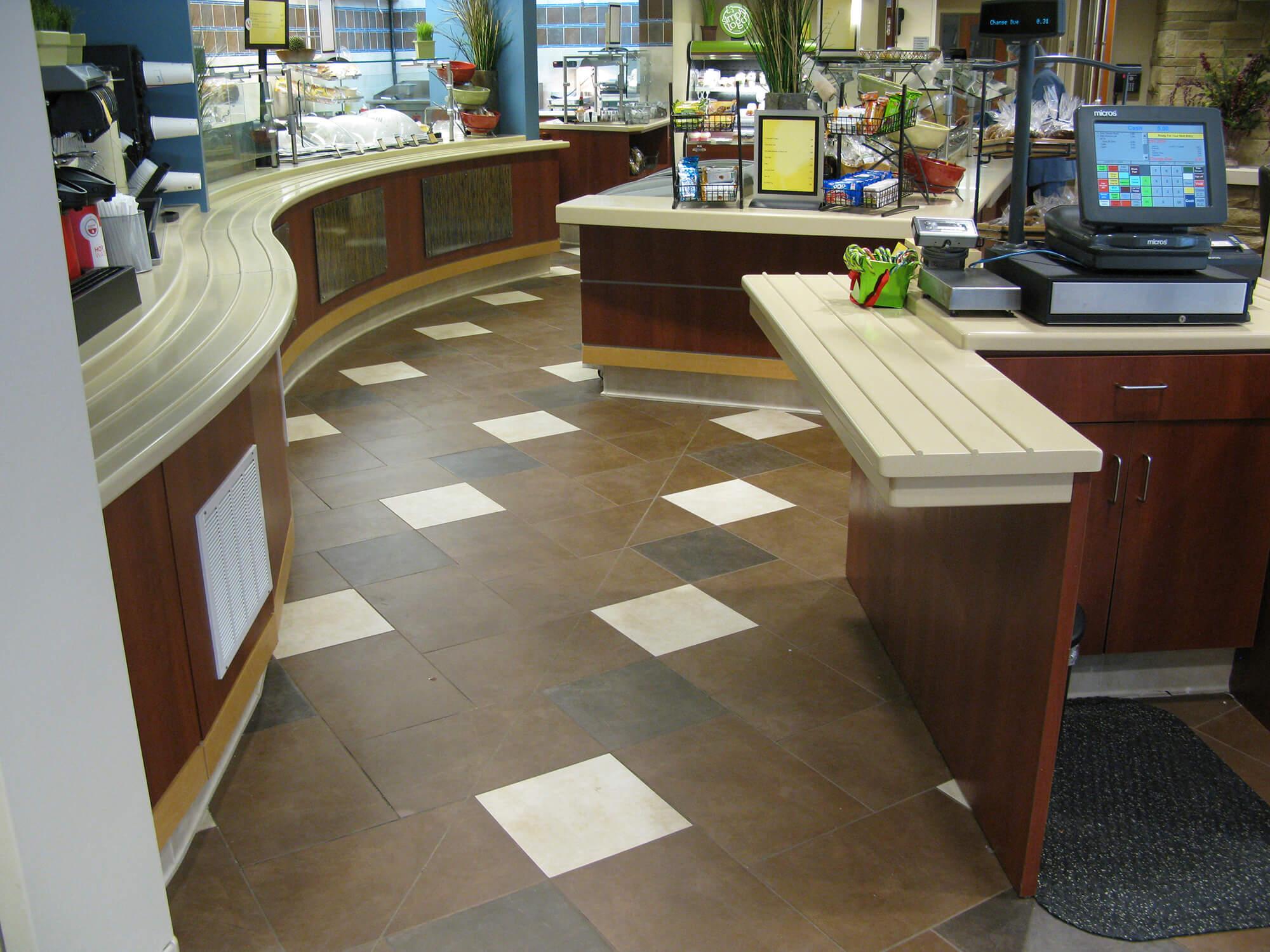
Tile samples usually arrive with a color conversation. Grout deserves an operating conversation: what lands on this floor, what removes it, and how soon does the room need to reopen?
For northeast Indiana schools, restaurants, offices, and public facilities, the answer can change from one side of a doorway to the other. A cafeteria serving line sees different conditions from the dishwashing area behind it. A public restroom has a different cleaning routine from a dry office lobby. Choosing one grout throughout the building simply because it matches the tile can overlook those differences.
Specify grout against the actual room use and cleaning program, then confirm the exact product, color, installation requirements, and return-to-service schedule. “Commercial grade” and “epoxy” are not complete specifications.
Start with a room-by-room exposure sheet
Before asking for a grout recommendation, collect information from the people who operate and clean the building. A useful sheet includes:
- the room and its tile assembly;
- typical spills, including food, grease, beverages, or process chemicals;
- cleaning product names and their current technical instructions;
- dilution, contact time, frequency, and whether the process includes rinsing;
- cleaning equipment, pads, brushes, and any hot-water or steam process;
- drainage conditions and areas where water remains after cleaning;
- cart traffic and areas that are difficult to reach beneath equipment;
- the available shutdown window and the first planned cleaning date.
Record the process that actually happens, not just the one in the original maintenance manual. If the janitorial contractor changes products, the flooring team needs to know before specifying the replacement grout.
For example, a school might use one cleaning program in its dining area and a different no-rinse cleaner behind the serving line. That should trigger separate product reviews, even if both rooms use the same tile. This is a planning example, not an account of a particular F & M installation.
Compare grout categories without treating them as interchangeable
Use this table to organize questions for the designer and product manufacturer. It is not a blanket approval for a room type.
| Option to evaluate | What to review | What not to assume |
|---|---|---|
| Cementitious grout | Published application limits, stain resistance, joint width, cleaning instructions, and any sealing requirements | That every cement-based product requires sealing or has the same performance |
| Epoxy grout | Exact formulation, tile compatibility, chemical-resistance information, installation cleanup, and cure requirements | That all epoxy grouts tolerate every commercial cleaner or exposure |
| Specialized industrial grout | Written suitability for the specific chemicals, cleaning process, temperature, and service conditions | That a product-family name or preferred color identifies the correct formulation |
Current manufacturer information illustrates why the details matter. LATICRETE describes PERMACOLOR Grout as a high-performance cementitious grout, states that it exceeds ANSI A118.7 requirements, and says its current formulation no longer requires sealing. A specification based on the assumption that all cementitious grout needs a sealer would miss that distinction.
The same manufacturer describes SPECTRALOCK PRO Premium Grout as an epoxy grout meeting ANSI A118.3 performance requirements and requiring no sealing. However, its published “stainproof” claim is specifically qualified for residential installations and common household exposures. Do not turn that language into a promise about every commercial kitchen spill or cleaner.
These are examples of how to read product information, not a requirement to use a particular brand. Obtain the current technical data and written suitability for the project’s actual conditions before approval.
In kitchens, the cleaner can determine the selection
A kitchen grout specification needs more detail than “epoxy grout, gray.” Ask the manufacturer to review the proposed cleaner and service exposure together. Provide concentration, contact time, rinsing practice, temperature, and frequency rather than asking whether the grout is simply “chemical resistant.”
There can be meaningful differences within one product family. LATICRETE’s current SPECTRALOCK 2000 IG information distinguishes its Midnight Black unit for installations needing its highest chemical resistance, including back-of-house areas with heavy use of no-rinse cleaners, from gray units recommended for front-of-house and other general commercial or industrial applications.
The practical lesson is not that every kitchen needs black grout. It is that the exact product configuration may matter as much as the category name. If the selected color is unavailable in the formulation needed for the cleaning program, resolve that conflict during design. Do not substitute a different unit on delivery day because the packaging looks similar.
Ask for the applicable chemical-resistance data and any limitations in writing. If the exposure is not covered, obtain manufacturer guidance rather than extrapolating from a different chemical or concentration. Save that response with the approved submittals.
Keep grout, movement joints, and water management separate
Grout selection is one part of a commercial tile assembly. It does not settle drain details, slopes, waterproofing requirements, or movement accommodation.
The Tile Council of North America’s grout guidance explains why changes in backing surfaces and changes of plane need appropriate flexible joints rather than rigid grout: those surfaces can move independently. Have the project team identify and detail the movement joints for the actual assembly. Do not fill a specified flexible joint with the field grout just to make its appearance uniform.
Likewise, do not treat a grout upgrade as the solution to standing water or a suspected leak. Have the underlying condition investigated and the required assembly details reviewed. A new grout color can improve appearance; it cannot establish that the floor’s drainage or waterproofing design is adequate.
Our commercial flooring installation guide covers the wider coordination of substrate, assembly, sequencing, and maintenance.
Approve a mockup that includes cleanup
A grout chip is useful for narrowing colors, but it cannot show the entire installed result. For a repeated or prominent area, request a sample panel or representative mockup using the actual tile, proposed grout, joint width, and cleaning procedure.
Review these points before extending the work:
- Appearance: Does the cured grout work with the tile under the room’s lighting?
- Tile compatibility: Does the manufacturer require testing or special preparation for this tile surface?
- Cleanup: Can installation residue be removed using the approved process without changing the tile finish?
- Joint profile: Is the completed joint consistent with the specified detail and suitable for the planned maintenance routine?
- Maintenance: Can the facility team follow the approved cleaning instructions with its available staff and equipment?
Do not choose the joint width solely to minimize visible grout. TCNA identifies tile variation, edge shape, size, surface characteristics, and location among the factors affecting joint selection. Use the project specification, current applicable standards, and tile and grout instructions to settle the width before installation.
Keep the approved mockup or documented first-area review available as a reference. If the tile, grout, color, or cleaning process changes, review whether the approval still applies.
Schedule reopening by the activity, not one “dry” time
A floor can have several different release milestones. Foot traffic, equipment movement, wet cleaning, and chemical exposure should not automatically share one date.
Ask the installer to build a product-specific schedule covering installation, initial cleanup, protection, and each return-to-service milestone. Confirm the site conditions required by the manufacturer and who will keep those conditions in place. Do not assume that a fast-setting description authorizes the first full cleaning shift immediately after grouting.
For a kitchen renovation, put the first washdown or chemical cleaning on the schedule alongside reopening. For a school, include custodial setup and equipment movement before students return. If the shutdown is too short for the selected system, review the product choice or phasing before work begins; do not rely on an improvised cure-time reduction.
See our occupied-facility flooring guide for coordinating closures and access with the rest of the building.
Make bids comparable and handover usable
Ask proposals to identify the grout manufacturer, exact product and formulation, color, joint-width assumptions, and locations. Include mockups, installation cleanup, protection, and any specified sealing. Separate work on existing joints or damaged tile from new installation so bidders are pricing the same scope.
For regrouting, investigate why the existing joints are deteriorating before selecting a replacement. Document loose tile, cracks, contamination, recurring wet areas, and the cleaning history. Ask the contractor to define removal, preparation, repairs, and limitations. New grout should not be presented as a guaranteed cure for an unresolved assembly problem.
At handover, give the facility team the approved cleaning instructions and product records—not merely the color name. Assign responsibility for reviewing future cleaner changes. Compare these operating requirements in the lifecycle-cost review, rather than comparing grout purchase cost alone.
Pre-approval grout checklist
- Map the rooms and their actual service exposures.
- Collect current cleaner names, instructions, and dilution practices.
- Document cleaning temperatures, frequency, contact time, and rinsing.
- Obtain written product suitability for the intended conditions.
- Confirm the exact formulation and color, not just the product family.
- Coordinate tile compatibility, joint width, and movement-joint details.
- Review a representative mockup and its cleanup procedure.
- Schedule traffic, equipment, wet cleaning, and chemical exposure separately.
- Align bids on preparation, protection, cleanup, and any sealing.
- Deliver maintenance instructions and a process for reviewing cleaner changes.
Questions owners and specifiers ask
Is epoxy grout always the right choice for a commercial floor?
No. Evaluate the specific room, exposure, tile, installation requirements, maintenance program, and budget. An epoxy category label does not establish suitability for every chemical or process, and a cementitious product should not be ruled out without reviewing its published performance.
Does grout that needs no sealing also need no maintenance?
No. “No sealing required” describes one maintenance requirement; it does not eliminate cleaning, spill response, inspection, or compliance with the manufacturer’s instructions.
Can we change cleaning products after installation?
Review the proposed change against the installed tile, grout, sealants, and other assembly components before use. Keep written compatibility guidance and updated instructions with the maintenance records. Do not assume a replacement cleaner behaves like the previous one because both are marketed for commercial floors.
Can grout selection alone make a floor compliant or hygienic?
No. Product properties do not establish whole-facility compliance, infection-control performance, or the effectiveness of a cleaning program. The project team must address the complete assembly and applicable operational requirements.
Bring the cleaning plan with the tile samples
The most useful grout discussion starts before bidding, with a room list and the maintenance products the building will actually use.
F & M Tile & Terrazzo has served northeast Indiana since 1958. Planning a commercial tile renovation in Fort Wayne or the surrounding region? Send us your plans or call 260-483-6389. Include the tile selections, room uses, cleaning instructions, and shutdown window so the flooring conversation addresses both installation and daily operation.